Meme coin trading with a $10 bankroll works when each buy stays under 0.05 SOL and fees are counted first
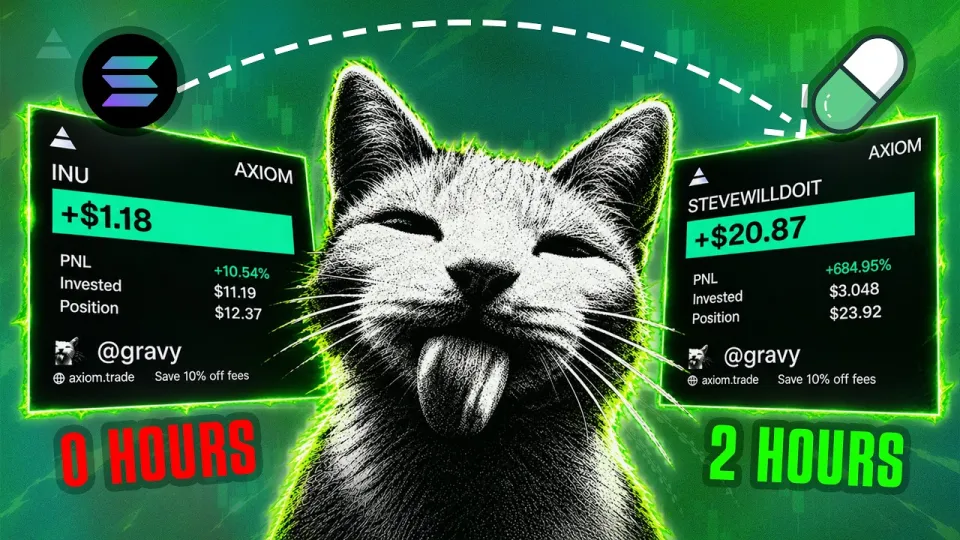
Video: I Tried Trading Memecoins with Just $10
Need articles like this for your video? They help promote it on YouTube and Google — order them in the Telegram bot @sat_sit_bot. Articles with your video embedded are written and posted by the bot itself — on popular topical sites (no ads). Try it free: 50 articles on us.
· based on the channel gravy
Key takeaways
- The experiment ran five real meme coin trades on Solana, and no single buy exceeded 0.05 SOL.
- Positions were sized in SOL, not dollars, so each entry stayed a small fraction of the roughly $10 bankroll.
- Tickers covered included STEVEWILLDOIT, NPC, MET (Meteora), PUMPY the Trader and UNTXD.
- Trades were executed through Axiom, which the creator promotes with a referral link offering cashback and lower fees.
- The honest result included one badly fumbled trade, so the video is a process breakdown rather than a profit claim.
Meme coin trading with a $10 bankroll is possible, but only if every buy stays tiny and fees are treated as a real cost rather than an afterthought. In a five-trade experiment on Solana, none of the buys went over 0.05 SOL, and each entry, exit and mistake was walked through step by step. The trades were placed through Axiom, the trading terminal used in the video, where the creator's referral link advertises cashback and reduced fees.
The point of the exercise was to test a claim that circulates constantly in crypto circles: that small accounts cannot trade meme coins because gas, swap fees and slippage eat the whole position. Five trades is not a statistical sample, but it is enough to see where the real friction sits and which habits separate a workable small-account routine from gambling.
What $10 actually buys on Solana
A $10 bankroll is workable on Solana mainly because transaction costs are denominated in fractions of a cent, not because $10 is a meaningful amount of capital. Solana fees per transaction are typically a tiny fraction of a cent, but the costs that matter for meme coins are different: swap fees on the venue, priority fees when the network is busy, and slippage on thin liquidity.
Position sizing is the first discipline. If a single buy is capped at 0.05 SOL, a roughly $10 account can take several positions or scale in without ever being all-in on one ticker. That cap is the whole strategy in miniature: it limits the damage from a rug or a badly timed entry to a small, survivable loss.
Three costs to count before every trade:
- The platform or aggregator fee on each swap, charged on both entry and exit.
- Priority fees, which rise when the chain is congested and can quietly exceed the trade's expected edge.
- Slippage, which is worst on new launches with shallow pools and large spreads.
On a 0.05 SOL buy, a round trip of fees plus slippage can consume a noticeable share of the position before price moves at all. That is the honest argument behind "you can't do this with $10" — and the reason the experiment used tight sizing rather than one big bet.
The five trades and the narratives behind them
The experiment covered five tickers, each chosen for a story rather than a chart pattern. The selection included STEVEWILLDOIT, NPC, MET (tied to Meteora), PUMPY the Trader and UNTXD. Each trade was explained on three points: why the buy was made, why the exit happened, and what the outcome was.
Meme coin prices are driven by attention, so the narrative is the asset. A ticker attached to a running joke, a known product or a live meta can attract buyers within minutes; a ticker with no story dies quietly. The video also touched on why a specific meta around X Money ran, referencing e/acc and Cream as part of the cultural backdrop that gave those coins traction.
The structure of the review matters more than the tickers themselves. For each position the creator described the entry thesis, the invalidation point and the exit, including one trade that was fumbled badly. That last one is the most useful part: a small account survives on honest post-mortems, not on highlight reels.
Why small portfolios fail on fees and behavior
Most small-account losses in meme coins come from behavior, not from the fee schedule. The classic pattern is buying a dip that keeps dipping, selling at a 20–40% loss, and then watching the same coin run higher without you. That sequence is a sizing and planning problem: without a predefined exit, every red candle becomes a decision, and decisions made in a hurry are usually wrong.
A second failure mode is narrative overload. Tracking every tweet, remembering which accounts carry influence and judging whether a community is real is genuinely exhausting, and by the time a story looks obvious the early buyers are already selling into it. The fix is narrowing the funnel: follow fewer sources, write down the thesis in one sentence before buying, and skip anything that cannot be explained that briefly.
A third is fee blindness. Traders calculate upside in percentage terms and forget that a round trip on a thin pool can cost several percent before the price moves. With 0.05 SOL entries, that cost is small in absolute terms but large relative to the position — which is exactly why the experiment tracked every trade instead of only the winners.
A repeatable routine for a sub-0.05 SOL account
A small meme coin account works best as a checklist that runs the same way every time, regardless of how exciting the ticker looks. The routine below follows the logic of the five-trade experiment.
- Cap the entry. Decide the maximum SOL per buy in advance — 0.05 SOL in this case — and never exceed it because a setup "looks amazing."
- Write the thesis in one line. If the reason to buy cannot be stated in a sentence, the trade is a lottery ticket.
- Define the exit before entering. Set both a loss level and a target, and accept that a 20–40% drawdown on a meme coin is normal noise, not a signal to panic-sell.
- Check liquidity and holder distribution. Thin pools and concentrated holders turn a small exit into a large slippage bill.
- Count the round trip. Add platform fee, priority fee and expected slippage to the cost basis before deciding the trade is worth taking.
- Log the result. Record entry, exit, reason and lesson, so patterns in your own behavior become visible.
Common questions from small-account traders
Small-account traders tend to ask the same things, and the answers are mostly about expectations rather than tactics. The most frequent question is whether a $10 account can produce meaningful profit; the honest answer is that the goal at this size is learning the mechanics and building a repeatable process, because the absolute returns will stay small.
Another recurring theme is how to find coins with good narratives without drowning in social media. The practical approach is to follow a short list of accounts that consistently surface stories early, mute the noise, and accept that missing most launches is normal. Buying every narrative is not a strategy.
A third is whether to scale up after a few good trades. The safer path is to increase size only after the routine has survived a losing streak, since a process that only works in a friendly market is not a process. The same logic applies to live trading in public: streaming a 0.1 SOL account is a test of discipline, not a shortcut to profit.
Useful links
- Axiom trading terminal with the creator's referral — the platform used for the five trades, advertising cashback and lower fees.
- The Trenches Discord — community linked in the video.
- Discord with free Axiom imports and trade signals (NFA) — second community invite from the description.
- Creator's X profile — where trade ideas and updates are posted.
- Bitbase leverage trading with reduced futures fees — the referral link for leveraged futures, unrelated to spot meme coin trades.
Bottom line
Trading meme coins with $10 is not impossible, but it is a training exercise rather than an income plan. The five-trade experiment shows that keeping every buy under 0.05 SOL, counting fees and slippage up front, and reviewing each exit honestly is what makes a small account survivable. The channel gravy built the whole breakdown around that idea, including the trade that went wrong, which is the part most tutorials leave out. Anyone repeating the test should start with the Axiom referral link used in the video and treat the first month as tuition, not as a return target.
Source: I Tried Trading Memecoins with Just $10 · Markdown version
Questions & answers
Can you really trade meme coins with only $10?
Yes, technically — Solana transaction fees are fractions of a cent, so a $10 balance can fund several small buys. The constraint is not access but sizing: with entries capped around 0.05 SOL, each position is small enough that fees and slippage stay survivable, and so does a rug.
How much do fees and slippage eat on a 0.05 SOL buy?
It depends on the venue and the pool, but a round trip includes the platform swap fee on entry and exit, priority fees during congestion, and slippage on thin liquidity. On a position that small, those costs can take a visible share of the trade before price moves, which is why they should be counted before entering.
Why do small accounts lose money even when they pick good coins?
Mostly through behavior: buying a dip that keeps falling, selling at a 20–40% loss, then watching the coin recover without them. Without a predefined exit and a fixed position size, every drawdown becomes an emotional decision, and meme coin volatility makes those decisions expensive.
How do you find meme coins with strong narratives without endless scrolling?
Narrow the input: follow a short list of accounts that surface stories early, ignore the rest, and require a one-sentence thesis before any buy. Accept that missing most launches is the normal state — the goal is a repeatable filter, not catching every meta.